 Robert Russell Designs
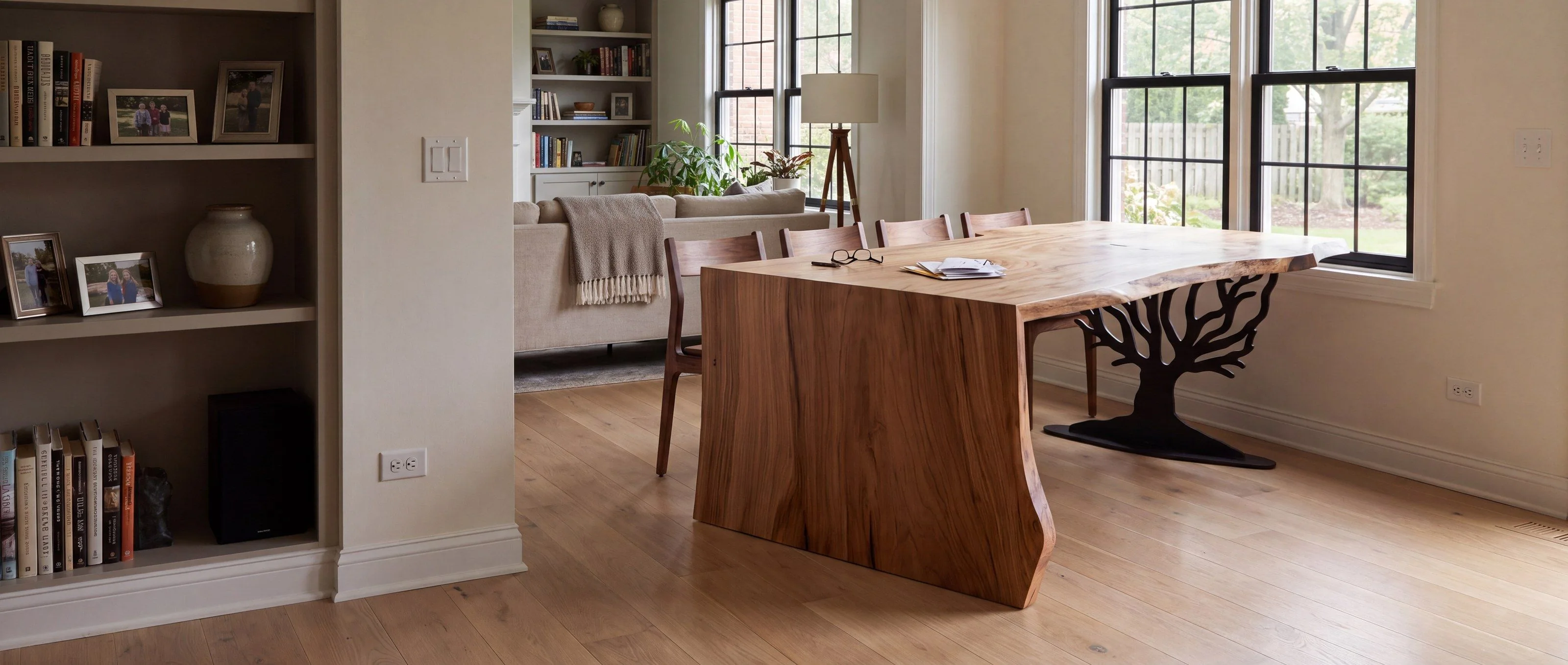
Shown in a rendered room
How thick should a dining table top be?
For solid hardwood, 1.75 to 2.5 inches. 1.75 inches is the long-standing standard for a straight-edge dining top, 2 inches is where a table starts to read as substantial, and 2.5 inches is slab territory. Below about 1.5 inches a solid top needs help from a frame underneath, and above 3 inches you are paying for weight the room will not notice.
What thickness is actually doing
Two separate jobs, and they pull in different directions.
Structural. A dining top spans between its supports. Thickness resists both sag across that span and the cupping that happens when one face of the board gains or loses moisture faster than the other. A thicker top is stiffer against both, which is why long tables tend to be thicker tables.
Visual. Thickness is most of what makes a table read as solid wood rather than as furniture. The edge is the only part of the top you see from across the room, and a 1.25 inch edge and a 2.25 inch edge tell you completely different things about what the table is.
The range in practice
| Thickness | Reads as | Typical use |
|---|---|---|
| 1.25 to 1.5 in | Light, refined | Veneered or frame-supported tops, smaller tables |
| 1.75 in | Standard hardwood | The common straight-edge dining top |
| 2 to 2.5 in | Substantial, slab | Live edge, single slab, most epoxy river tops |
| 3 in and up | Monumental | Statement pieces, short spans, heavy bases |
A live-edge top has a second consideration. The natural edge is rarely a constant thickness, so a slab that measures 2.25 inches through the middle may taper toward the bark line. That variation is the point of the piece, but it means “thickness” is a nominal number rather than a measurement that holds everywhere.
The clearance nobody checks
Thickness comes out of the space under the table.
Standard dining height is 30 inches to the top surface, and you want at least 24 inches from the floor to whatever is underneath, so knees clear. A 2.5 inch top leaves 27.5 inches before the base has done anything, which is fine. Add an apron, a thick stretcher or a wide bracket and that number falls quickly.
If the table is going to seat someone at the end, check the end condition specifically. It is the position where a base member and a pair of knees are most likely to want the same space. The sizing guide covers the rest of the clearance arithmetic.
Matching the base to the top
A thick top wants a base that can carry it visually as well as structurally. A 2.5 inch slab on a slender hairpin leg looks like a mistake even when the engineering is sound, because the eye reads the mass of the top and expects something underneath it.
This is usually where the decision resolves itself. Pick the top thickness for the piece you want, then choose the base that suits it, rather than the other way around. The collections are organized by base style for exactly that reason.
By Rob Showalter, furniture maker in Geneva, Illinois.
Related questions
- How thick should a solid wood dining table top be?
- 1.75 to 2.5 inches is the working range. 1.75 inches is the common standard for a straight-edge hardwood top, and 2 to 2.5 inches is where a slab or live-edge table starts to read as a slab rather than as a board.
- Is a 1 inch thick dining table top too thin?
- For a solid hardwood table at dining length, yes in most cases. Thin tops need either a short span, a supporting frame underneath, or a material that behaves differently from solid wood. Veneered and engineered tops are built that way on purpose.
- How thick is an epoxy river table top?
- Usually 2 inches or more. The resin pour and the slab have to be the same thickness, and slabs thick enough to survive flattening after a pour tend to land at 2 inches and up.
- Does a thicker top need a heavier base?
- Visually, yes. A 2.5 inch top over a slender base reads unbalanced, and the fix is usually a wider or more substantial base rather than a thinner top.
Next
- Dining Table Collections
- What size dining table do I need for my room?
- The Ultimate Guide to Live Edge Tables: Styles, Costs & Custom Design Tips (2025)
- Begin a commission
Last reviewed September 21, 2026