 Robert Russell Designs
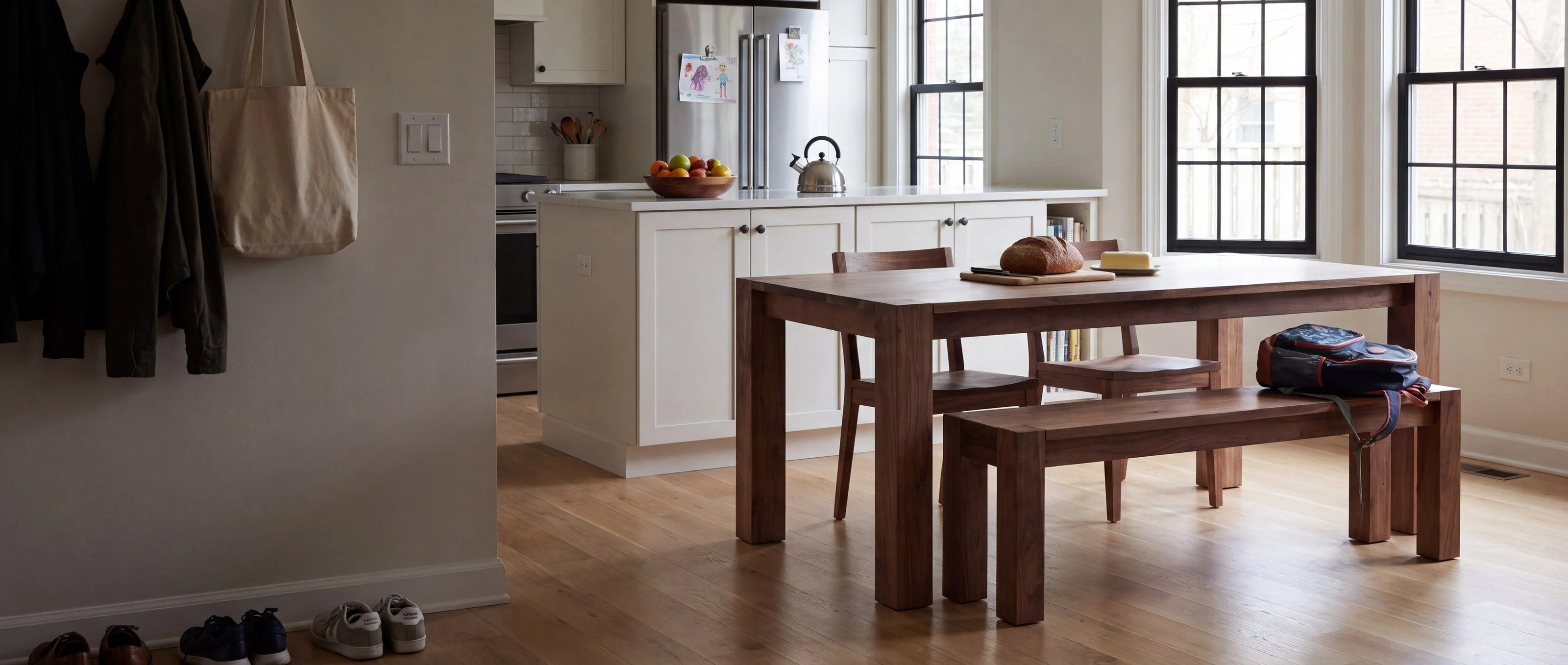
Shown in a rendered room
What is the difference between a single slab, a bookmatched and a multi-board table top?
A single slab top is one board, full width, no joints. A bookmatched top is two boards from the same log opened like a book so the grain mirrors across the center. A multi-board top is three or more boards joined and arranged by the maker. The difference in price is mostly sourcing, not labor: the wider and cleaner the board, the rarer it is. Each method changes the look and character of the finished piece.
Single slab
One tree, one board, one top.
The appeal is obvious and hard to fake. The grain runs uninterrupted from one end to the other, the two live edges are the two sides of the same trunk, and nothing about the surface asks you to ignore a joint.
The constraint is supply. A dining top at 42 inches wide needs a log that was wider than that, sawn through and through, dried for years without checking or twisting badly, and still clean enough to use. Those slabs exist and they are scarce, which is why the price lives where it does and why the choice is usually made from what is actually available rather than from a specification.
Movement is the other consideration. A wide single board moves more across its width than a glued-up top of the same width, because the glue-up can alternate the grain direction of its boards. This is a reason to care how the top is attached, not a reason to avoid slabs.
Bookmatched
Two boards cut in sequence from the same log, then opened so one is the mirror of the other.
The grain pattern is symmetrical about the center line, which the eye reads as deliberate and calm. It gets you close to the visual effect of a single slab at widths where single slabs run out, and the two mirrored live edges facing each other down the middle are the natural place for a resin river, which is why almost every river table is built this way. The epoxy river collection shows what that looks like across different pours.
What to look at is the joint. A bookmatch is only as convincing as the match at the center, and that depends on the boards having been sawn in sequence and kept together.
Multi-board
Three or more boards, selected and arranged.
This is the construction that makes long, wide, flat, stable tops possible, and it is what most fine furniture has been made from for centuries. The maker chooses the order, the orientation and the joint placement, so the grain across the top is a composition rather than an accident.
It is also the most predictable of the three. Boards of moderate width are easier to dry correctly, easier to keep flat, and available in any species you want at any length. If the room needs a 12 foot table in a species that does not grow wide, this is the answer.
Choosing between them
| Single slab | Bookmatched | Multi-board | |
|---|---|---|---|
| Joints in the field | None | One, at the center | Two or more |
| Width limit | The tree | Two boards | None in practice |
| Sourcing difficulty | High | Moderate | Low |
| Relative cost driver | The slab itself | The matched pair | Labor and selection |
| Reads as | A piece of a tree | A composed pair | Fine furniture |
There is no ranking here that survives contact with a real room. A single slab in a species with quiet grain can be less striking than a well arranged multi-board top in figured walnut, and a bookmatched pair with a resin river is a different category of object from both.
The practical route is to start from the size you need, which the sizing guide will give you, then see what is available at that width. Slabs are chosen for your table specifically, arranged against your dimensions, and drawn before anything is cut, so the construction decision gets made once you can see it.
By Rob Showalter, furniture maker in Geneva, Illinois.
Related questions
- What is a single slab table?
- A top cut from one board, full width, with no glue joints. It is the hardest of the three to source at dining width because the tree has to have been wide enough, and it is the one that reads most clearly as a single piece of a tree.
- What does bookmatched mean?
- Two adjacent boards from the same log, opened like the pages of a book so the grain mirrors across the joint. It gives a symmetrical top with a visible center line, and it is the standard construction for an epoxy river table.
- Is a multi-board top lower quality?
- No. A well made multi-board top, with the boards selected and the grain arranged deliberately, is stable, repeatable and available in sizes no single slab could reach. It is a different aesthetic, not a lesser one.
- Which one is most expensive?
- Single slab, generally, because the cost is in the sourcing rather than in the labor. A wide, clean, properly dried slab at dining length is a scarce object and is priced like one.
Next
- Dining Table Collections
- Custom epoxy river resin tables with live edge
- How thick should a dining table top be?
- Begin a commission
Last reviewed September 21, 2026